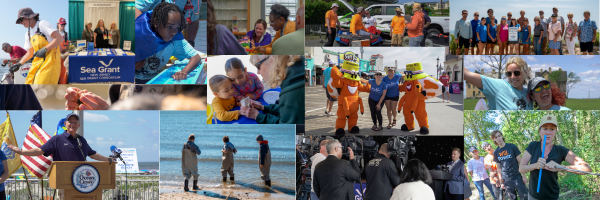
Things are definitely heating up at New Jersey Sea Grant Consortium this summer! While most New Jerseyans enjoy lazy, carefree days spent at the Garden State’s vast array of gorgeous beaches, NJSGC’s staff is working hard to advance knowledge and appreciation of New Jersey’s shorelines.
From Ocean Fun Days to our biennial research competition and ongoing rip current awareness campaign, NJSGC strives to inform the public about coastal and environmental concerns in new and exciting ways.
Communicating climate sciences, learning more about the origins of striped bass, and engaging youth in summer camp experiences are just some of the interesting topics covered in this edition of our quarterly newsletter. You’ll also find out which popular shore town snagged top honors in NJSGC’s annual “Favorite Beaches” poll!
Topics covered in the latest edition of the ‘COASTodian’ include:
Where Are They Now? Meet Our Brilliant Staff! NJ’s Favorite Beaches 2017 Announcement State of the Shore Report Ocean Fun Days (recap) Rip Current Awareness National Network for Climate and Ocean Change Interpretation Marine Summer Day Camp FY 2018 Budget (update) NJSGC Broadcasting Live from Asbury Pary Boardwalk (94.3 ‘The Point’) Summer College Course Opportunities Striped Bass Fishery Project (update) Ocean County Pumpout Program Celebrates 20th Anniversary Share your #NJSGC memories
Learn more about all the exciting things happening at NJSGC everyday by following us on Facebook, Twitter, and Instagram, or visit njseagrant.org for any further updates.
Thank you for your submission. Please remember that your recommendations and school transcript must be received by April 17, 2015.
Applications must be received by the deadline to be considered by the committee.
Only complete applications will be considered for awards. Complete applications consist of an application form, school transcript and two completed reference forms.
Your transcript must be sent directly from your school to the following address.
Stew Tweed Scholarship Fund
c/o New Jersey Sea Grant Consortium
22 Magruder Rd.
Fort Hancock, N.J.
Awardees will be notified around May 1, 2015. Scholarship winners must make arrangements to accept the award at Ocean Fun Days on Sunday, May 17, 2015, at the New Jersey Sea Grant headquarters on Sandy Hook.
Join us in stewarding New Jersey’s coastline! As we look ahead to 2026, we take pride in all that we have accomplished together and remain committed to our mission of safeguarding and sustaining our coastal environment. At the New Jersey Sea Grant Consortium (NJSGC), we envision resilient shores, healthy marine ecosystems, and informed communities that value and fortify our state’s remarkable natural resources.
Your support is an essential part of this vision. Every contribution strengthens our education, communication, extension, and research programs that keep our coasts and the people who depend on them strong. In 2025, thanks to generous donors like you, we achieved meaningful progress in advancing coastal science and stewardship.
2025 Accomplishments:
The22nd Annual Ocean Fun Days was again a success!
NJSGC supported research focused on cleaner water, resilient coasts, sustainable aquaculture, marine innovation, and community-driven solutions to pollution and climate challenges.
Received thousands of responses across our Jersey Shore Photo and Favorite Beaches Contests.
Apprenticeship in Shellfish Aquaculture Program’s 3rd year generated greater interest in our local shellfish industry.
Conducted an assessment of the condition of boat ramps open to the public.
Over this past spring through fall alone, we hosted 47 diverse Scout Programs, providing young scouts the opportunity to earn the Environmental Science and Oceanography badge.
Engaged thousands of young citizens through field trips, in-school programs, scouts, and summer camp.
With your continued partnership, we can build on this momentum and make an even greater impact in the year ahead. Our work is more needed than ever, and your support is vital to our continued success.
By donating to NJSGC, you contribute directly to initiatives like:
Inspiring future science communicators by continuing our summer Communications Internship.
Fueling coastal innovation by providing additional support to our student researchers through our Omnibus Research Grants.
Empowering high school students through our Apprenticeship in Shellfish Aquaculture Program, providing paid aquaculture training and career-building experiences that support our coastal economy.
Keeping Ocean Fun Days free and open to all, ensuring families can celebrate our coast together.
Opening doors for young explorers by helping launch a summer camp scholarship fund for families experiencing financial hardship.
Expanding our coastal impact by improving communications tools that grow community engagement.
Ways to Give
Your support helps build a future where our communities are informed, our coastlines are stronger, and new generations are inspired to support New Jersey’s shore.
Every contribution, big or small, keeps our mission moving forward through educational opportunities, research, and community programs and events.
Click the button below to make a donation or explore other ways to get involved.
Thank you for being such an important part of our consortium family and for your continued dedication to New Jersey’s coasts. We’re so grateful for your support and can’t wait to see what we’ll accomplish together in 2026.
If you’d prefer to mail your gift, please send it to:
Deborah Meehan Quinn New Jersey Sea Grant Consortium 22 Magruder Road Fort Hancock, NJ 07732
Please click on the “Donate” button above to process your secure on-line payment via PayPal.
The Education Program at the New Jersey Sea Grant Consortium conducts a wide variety of programs directed towards advancing greater understanding and stewardship of our state’s marine and coastal resources. Collectively, these programs engage a large and diverse audience of learners. Our K-12 field trip program alone provides instruction to over 20,000 school children annually, taking them out of the classroom and onto the beaches, bays, and estuaries of New Jersey for active learning experiences.
Every Kid Outdoors Program provides FREE field trips for 4th graders during the 2025-2026 school year! Click here for more information about NJSGC and the Every Kid Outdoors Program.
Contact our Education Department, reservations@njseagrant.org, for additional information about these and other educational opportunities at NJSGC.
(Sandy Hook, NJ) — Congressman Frank Pallone (NJ-6th District) will be at Sandy Hook’s Historic Fort Hancock District at 12:15 pm on Sunday June 9th, 2013 for a special presentation of the 2013 Stew Tweed Fisheries and Aquaculture Scholarships during Ocean Fun Days an annual education-oriented ecotourism event coordinated by the New Jersey Sea Grant Consortium (NJSGC) which also sponsors the Stew Tweed Scholarship competition.
Help keep your community out of harm’s way with an Ocean Hazards and Beach Safety: Sharks vs. Rip Currents program, a lively presentation and interactive “Jeopardy”-style game that educates participants about rip current safety and shark biology, making comparisons to learn safe swimming practices. Participants will walk away with knowledge and insight that will keep them safe no matter which of the two they find at the Jersey Shore. This hour-long presentation is suitable for grades 3-12 or as a public presentation for families and life-long learners. Maximum number of participants is 60, and schools may request up to 2 presentations per day.
Please use this form to request a presentation, and be sure to provide three (3) possible dates. We will confirm receipt of your request with a reply email within a few days, and soon thereafter you will receive a program reservation confirmation along with program guidelines. Please contact For more information contact Samantha Maxwell-Kowal K-12 Program Coordinator at smaxwell-kowal@njseagrant.org or 732-872-1300 x 13 for additional information or questions. We look forward to working with you for a JAWSOME program of fun, safety and learning!
Ocean Hazards and Beach Safety: Sharks vs. Rip Currents
Get the shades and sunscreen ready! The fun-filled days of summer are fast approaching, which means it’s finally time to cast your vote for New Jersey’s favorite beach!
Starting today, fans get to choose their favorite local “hotspots” from a list of amazing beaches throughout the Jersey Shore’s four coastal counties – Atlantic, Cape May, Monmouth, and Ocean. New Jersey Sea Grant (NJSGC) will announce the winners around the July Fourth holiday.
This year’s poll debuted during a LIVE broadcast on the Asbury Park boardwalk with 94.3 “The Point.”
Debuting in 2008 as New Jersey’s “Top Ten Beaches,” the survey was initially designed to encourage friendly competition and camaraderie amongst popular Jersey Shore communities along the coast. Following Hurricane Sandy, the contest was rebranded “Favorite Beaches” to diversify results so that ALL areas of the Garden State’s gorgeous oceanfront are recognized, inspiring a refreshing sense of unity and support.
An overall victor is still announced, with Ocean City remaining undefeated champ over the past several years. But will that impressive winning streak end in 2019? Asbury Park has definitely proved a fierce competitor over the past couple years… You decide!
Be sure to share NJSGC’s highly-anticipated “Favorite Beaches” poll with family and friends, and stay tuned for the official results later this summer.
Connect with New Jersey Sea Grant Consortium on Facebook, Instagram, and Twitter for more updates. Thank you for your continued support!
Starting today, fans get to choose their favorite local “hotspots” from a list of all the amazing beaches throughout NJ’s four coastal counties – Atlantic, Cape May, Monmouth, and Ocean. The New Jersey Sea Grant Consortium will announce the winners around the July Fourth holiday.
Debuting in 2008 as New Jersey’s “Top Ten Beaches,” the survey was designed to encourage a little “friendly” competition and camaraderie between popular Jersey Shore communities along the sandy coast.
Now in its tenth year, the poll was recently rebranded “Favorite Beaches” to diversify results so that ALL areas of the Garden State’s gorgeous oceanfront were recognized. An “overall” victor is still announced, and Ocean City, NJ has remained undefeated champ over the past decade. But will that impressive winning streak end this year? You decide!
Be sure to share the 2018 “Favorite Beaches” poll with family and friends, and stay tuned for the official results later this summer.
Connect with New Jersey Sea Grant Consortium on Facebook, Instagram, and Twitter for more updates. Thank you for your continued support!
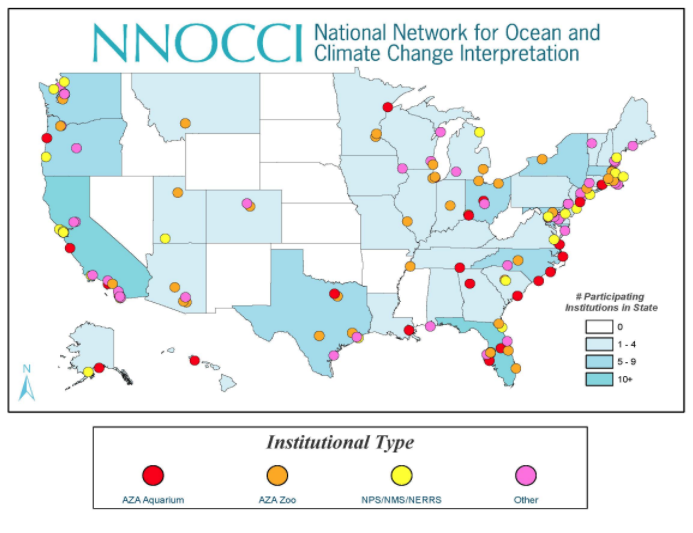
According to their website, NNOCCI (National Network for Climate and Ocean Change Interpretation) is a collaborative effort led by the New England Aquarium along with several other notable environmental organizations and institutions, working to establish a national network of professionals who are skilled in communicating and translating climate and ocean science to a broader public audience. The overall goal is to change the nature of public conversation about issues of climate change to be inviting, empowering and solutions-oriented.
NJSGC’s very own Education Specialist Mindy Voss and K-12 Program Coordinator Diana Burich recently teamed-up to complete this program, involving several weeks of hands-on training and interactive lessons through informative study circles. Voss and Burich hope to use such newfound experience and knowledge to help better communicate the impacts of climate change.
To learn more about Voss and Burich’s exciting involvement with NNOCCI, please continue reading below!
Can you give a brief overview of what NNOCCI is and your involvement?
NNOCCI stands for National Network of Ocean and Climate Change Interpretation. Their goal is to achieve a network of skilled and trained professionals who can effectively communicate ocean and climate science to public audiences to create a more positive conversation about climate change that is engaging, empowering, and solutions oriented. NNOCCI was created through a collaboration between the American Zoological Association (AZA), Woods Hole Oceanographic Institute, and FrameWorks Institute. NNOCCI, with the help of FrameWorks Institute, has looked through and done the social science research to find the most effective ways to communicate science and climate change to the public. Through a NSF grant, the research was turned into a training program for informal science educators, to teach them the social science and how to implement these scientifically-proven ways to talk to the public about climate change, and how to create a positive discourse around climate change that is solutions oriented. This training program has been on-going every Fall and Spring since 2014. However, this spring the training was broken down into smaller study circles, and instead of a few intensive weeks of in-person training for educators across the country, the program spread out over 17 weeks and was broken up into 3 regional study circles – a Southeast, Northeast, and West Coast. I was part of the Northeast study circle, which included 18 other informal science educators from Maine to New Jersey. The training included a variety of live and recorded webinars, online reading, interactive activities, and three (two-day long) in-person meetings. We were given an assignment to complete each week, and communicated with each other on climateinterpretor.org.
How did participating in the study circle develop and enhance your knowledge of ocean and climate change?
The biggest enhancement [I received] from the study circle is how to start and properly frame a conversation about climate change with a variety of audiences. I learned how to get others to understand why they should care about climate change [and] how to teach the science so that others can understand it, [including] the root cause of the problem. I learned techniques on how to keep the conversation positive, engaging, and hopeful, and how to steer away from the negativity and falsehoods that often surrounds climate change. I learned to make others realize that if people come together in their communities, schools, or other groups, there are solutions that can make differences to slow (or even stop) climate change.
How do you plan on utilizing these new skills in your own study and teaching environment?
Besides just framing a conversation about climate change in the educational programs that I do, I plan [on] passing on all of the communication skills I learned to all our educators and field instructors at NJ Sea Grant. Next fall and winter I will be holding a few different training days to give staff an opportunity to learn these new skills. It is my goal that all field trips at Sandy Hook will include a properly framed conversation about ocean and climate change with students [starting] in grade three up through college years. I will also pass along many of these skills to formal and informal educators at various professional development workshops that NJSGC participates in every year.
How might the NJSGC community benefit from your ongoing connection and work with the program?
Everyone in the NJSGC community will get a chance to learn the scientifically proven and effective techniques I learned about communicating climate change. I think this will improve many of our programs and interactions with the public, so people better understand why some of the work done (and science research funded) by NJSGC is so important. For the education program, it is my goal that all field trips given by NJSGC at Sandy Hook will include a properly framed conversation about ocean and climate change for all ages. My hope is that all students walk away from a field trip knowing the definition of climate and the ocean’s role in controlling it, understanding what climate change is and its impact on marine environments, why they should care, and what they can do about it.
I also made some great contacts through this program, from scientists at universities to educators at other educational programs in the area,. Hopefully we will be able to collaborate on future projects with them to improve or create new programming at NJSGC. For example, through a contact I made [through NNOCCI], we already have a grant proposal out in collaboration with the Student Conservation Association (SCA) to create a six-week long educational work study program for under-served high school students in Monmouth County. This proposed program will help students learn how park and recreation activities along with protected natural environments enhance and create value in their communities. We just put in the proposal, so the grant has not yet been approved.