Happy Holidays and 2016 Highlights in Coastodian
Happy holidays from New Jersey Sea Grant Consortium.
Please check out our year-end newsletter to see what we’ve been up to and reflect on some of the highlights of 2016.
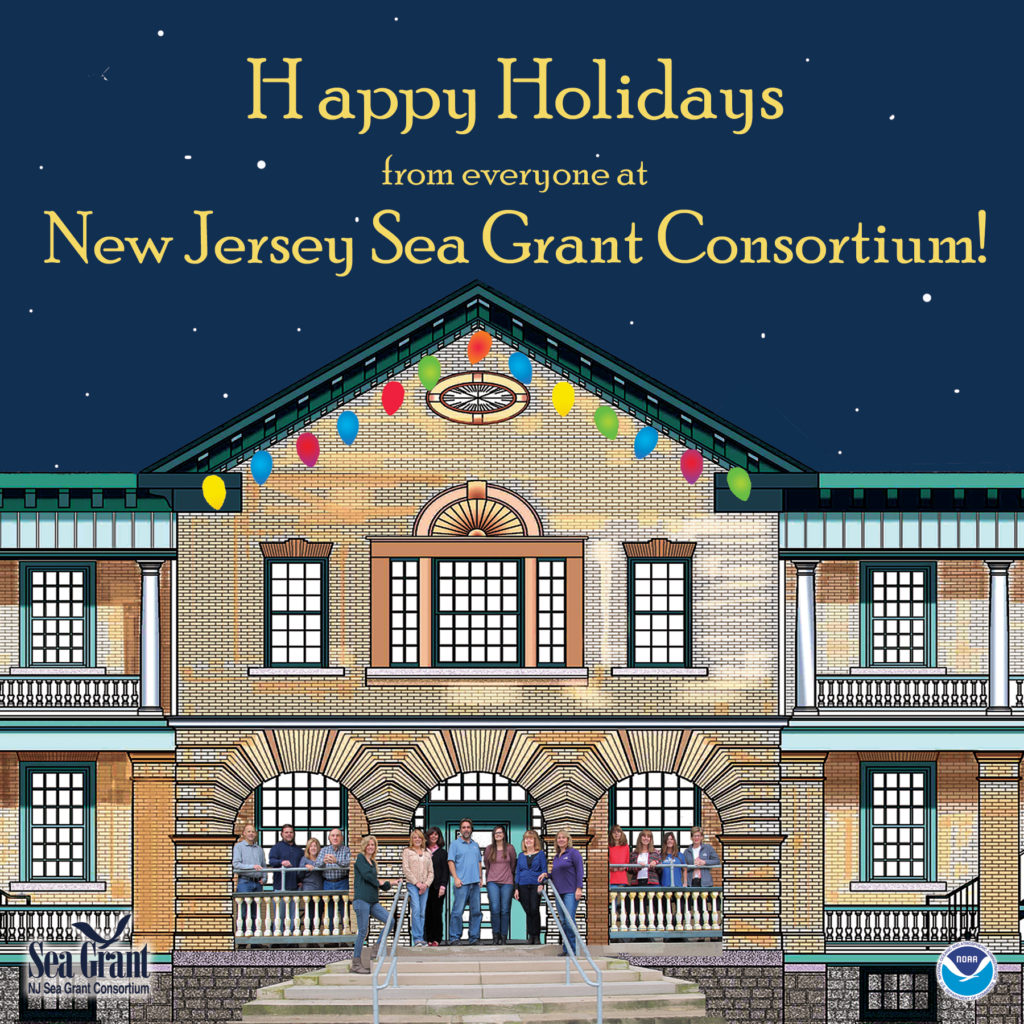
Happy holidays from New Jersey Sea Grant Consortium.
Please check out our year-end newsletter to see what we’ve been up to and reflect on some of the highlights of 2016.
UPDATED
The New Jersey Sea Grant Consortium manages and offers several fellowships each year in conjunction with the National Sea Grant College Program and other federal partners, including the National Oceanic and Atmospheric Administration and the National Marine Fisheries Service. Deadlines are fast approaching for three fellowships in January and February of 2018:
The NOAA/Sea Grant Coastal Management Fellowship provides two years of on-the-job education and training in coastal resource management and policy for postgraduate students. The program matches postgraduate students with state coastal resource agencies to work on coastal projects proposed by state officials and selected by the NOAA Office for Coastal Management. Deadline to apply is January 19, 2018. For general information on the Coastal Management Fellowship go to: http://coast.noaa.gov/fellowship/.
The NOAA/Sea Grant John A. Knauss Marine Policy Fellowship matches graduate students interested in ocean resources and the national policy decisions affecting them with “hosts” in the Washington, D.C. area for a one-year paid fellowship. Any student, regardless of citizenship, is eligible if enrolled towards a degree in an accredited graduate program. Interested applicants must apply through their local Sea Grant Program. New Jersey applicants are strongly encouraged to reach out to Dr. Peter Rowe or Ms. Claire Antonucci a minimum of one month prior to the state application deadline to provide notification of their intent to apply and request application support. Applicants should also allow sufficient time to schedule an interview at the program’s request. The state application deadline for New Jersey students to submit their final application package to NJSGC is February 23, 2018, 5pm local time. For more information on the Knauss Fellowship go to: http://seagrant.noaa.gov/Knauss.
The NOAA Fisheries/Sea Grant Joint Graduate Fellowship Program in Population and Ecosystem Dynamics and Marine Resource Economics is designed to strengthen the collaboration between Sea Grant and the National Marine Fisheries Service (NMFS). The Fellowship is available to US citizens who are graduate students enrolled in PhD degree programs in academic institutions in the United States and its territories. Fisheries Fellows will work on thesis problems of public interest and relevance to NMFS at participating NMFS Science Centers or Laboratories under the guidance of NMFS mentors. Deadline to apply is January 26, 2018. For general information on the NOAA Fisheries/Sea Grant Fellowships go to:
http://seagrant.noaa.gov/NMFS-SG-Fellowship.
Read more about these fellowships and how to apply here.
|
|
|
Join New Jersey Sea Grant Consortium and Jenkinson’s Aquarium for a special Junior Keepers Underwater Exploration program on August 12 at the Aquarium located on the boardwalk in Point Pleasant Beach. Campers will learn why we explore our oceans and how aquariums play a role in conservation. Find out what happens behind the scene at the aquarium, and work in teams to design, build and deploy a remotely-operated underwater vehicle in one of the tanks. The four-hour program is recommended for ages 11 to 15 and costs $80 per child. Space is limited so do not hesitate to sign up. To register call Jenkinson’s Aquarium at 732-899-1659.


Lights, camera, action! Dr. Peter Rowe, associate director for Sea Grant Administration and director of research and extension, and Mindy Voss, education specialist, were featured in an episode of Aqua Kids TV. During the day of filming at Sandy Hook, Rowe and Voss took the Aqua Kids seining to explore the biodiversity of Sandy Hook Bay.
Aqua Kids is an award-winning K-12 program that airs nationally. Reaching more than 90 million households, the program aims to educate children about ecology, wildlife and science. The show has won two Emmy awards.
Sea Grant works with coastal communities around the country to strengthen their ability to plan, adapt, and recover to coastal hazards. As part of an effort to visualize the wide breadth of community resilience projects across the National Sea Grant program, Delaware Sea Grant developed this interactive story map.
This originally appeared in the Spring edition of New Jersey Sea Grant Consortium’s newsletter, Coastodian.
Dr. Robert Kopp’s NJSGC-funded project, Development of Historically-Calibrated Sea Level Rise Projections for Risk Management Along the New Jersey Shore, found that sea level is rising at a faster rate than any time in the last 3,000 years. The findings were published in the journalProceedings of the National Academy of Sciences. Kopp, the lead author, is a professor in the Department of Earth and Planetary Sciences at Rutgers University. The study was covered by the The New York Times, Associated Press, NPR, Rutgers Today and many other outlets.

GALLOWAY — The levels of ocean acid are higher along the coastal waters of the Mid-Atlantic and Northeast than they are in along southern Atlantic coasts, which puts one of New Jersey’s growing industries at risk.
That’s a concern of regional marine scientists and other stakeholders across the Mid-Atlantic, who want to pull together to create a team to study and address the problem.
“We need to pull together in order to find solutions that reduce the impacts of ocean acidification on our ecosystems and shellfish industry,” said Dr. Peter Rowe, NJSGC’s director of research and extension.
They gathered at Stockton University in August for a discussion — organized in part by the New Jersey Sea Grant Consortium —with experts and stakeholders about the current state of New Jersey’s coastal waters and what threats OA, as it is called, poses to the Mid-Atlantic.
As oceans become more acidic, the nutrients available to shellfish become sparse. They can’t grow shells, or their shells become too weak.
The destructive potential for OA, as it is called, is a huge problem for the shellfish industry in the Northwest.
Between 2005 and 2009 shellfish production collapsed by 80 percent, according to a PBS report. In Washington State the industry is worth $270 million and employs thousands of people.
Daniel Cohen theowner of Atlantic Capes Fisheries, said that the Pacific Ocean acidification brought the indutry to its knees. Oysterman were hauling in 600 to 700 bushels of oysters with a value of $60 million, but that dropped to zero, he said.
“Research on ocean acidification and shellfish is just beginning here in New Jersey, and there are no indications of a serious problem at this time,” said Lisa Calvo, the New Jersey Sea Grant aquaculture specialist.
In New Jersey, shellfish harvesting has grown from $98.65 million in 2003 to $159 million in 2012, according to NOAA figures. And commercial fishing in general employed more than 50,000 people in 2012, and was worth $2.87 billion across all sectors.
Beyond the economic benefits of shellfish, they are critical to the environment.
To that end, several environmental groups have been working to rebuild shellfish reefs in Barnegat Bay, and the state Senate has approved a law that would open closed waters in Raritan and Sandy Hook bays to rebuilding oyster reefs for research purposes. The law has not passed the Legislature because a similar law has not yet recieved approval in the General Assembly.
And, Calvo, at the Rutgers Haskin Shellfish Laboratory, coordinates Project PORTS, or Promoting Oyster Restorarion Through Schools, which is an effort to build an artificial oyster reef in protected Delaware Bay waters.
“Oysters are filter feeders, they consume phytoplankton from the water and as they filter their food from the water they improve water quality. This is one of the most important ecological services that oysters provide,” Calvo explained. “ Additionally oysters form reefs as generations of oysters settle on one another. The oyster reefs serve as important habitat for many fish species and crabs.”
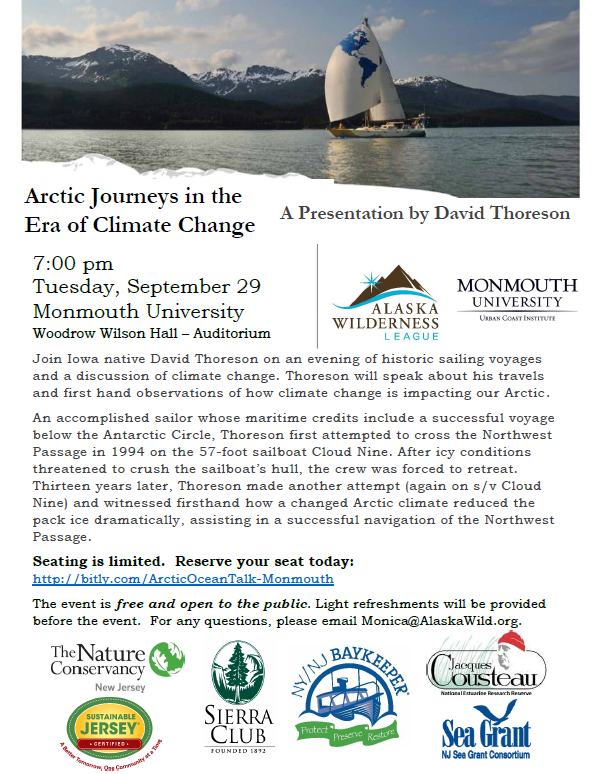
Dr. Jon Miller, the NJSGC coastal process specialist, spoke with CBS Radio on Friday about the possibility of weekend rip currents cause by a passing storm over the ocean.
Listen to the report here.
Sometimes, it’s easy to spot rip currents from shore, Miller said. But, they are not always visible. Miller’s advice is simple: swim near a lifeguard and don’t do things in the ocean that you know you’re not capable of doing.
Miller’s warning comes at a time when authorities have scoured the beach at Sandy Hook for two days looking for a missing 25-year-old man. His body was recovered Friday, according to the Asbury Park Press. Rip currents have not been identified in the man’s drowning. However, authorities told the Press the man was not a skilled swimmer and swam in the ocean after lifeguards had left the beach.
Last year, a 17-year-old boy drowned at Sandy Hook after being caught in a rip current.
For more information about rip currents such as how to identify them and what to do if you are caught in one, click here.

