Please accept our sincerest appreciation for your past support of Sea Grant and New Jersey Sea Grant Consortium. Last year, you reached out and told your elected officials how important Sea Grant is to you, our state, and the nation. You were most definitely heard. Congress soundly rejected the Administration’s proposal to eliminate all Sea Grant programs. This allowed us to continue to work with you on so many crucial issues including stormwater management, coastal resilience, supporting the shore tourism and boating industries, and providing environmental and STEM educational experiences for children, college students, and the public.
The Administration recently released its FY 2019 budget blueprint. Once again, it proposes the termination of the entire Sea Grant program and so, once again, we must ask for your help.
Please reach out to your elected officials as soon as possible to ask for their renewed support of the Sea Grant program. When you write or call your elected representatives, it is important to thank them for their past support and remind them why the Sea Grant program is crucial to New Jersey’s well-being and how our work has benefited you personally.
To help you develop your message, we have included a templatefor possible use in composing your message. To further assist you, this directory includes each of New Jersey’s elected officials, including email addresses for their aides. If you decide to write, please direct your letters to local offices (not DC). If you decide to call or fax, it is best to call both the local and Washington D.C. offices. If you decide to email, please write your message to your elected official, but use the email address provided in the directory for his or her aide. You can also locate your Senators and Representatives at https://callyourrep.co/ or text your home address to 520-200-2223 and you will receive a message containing the names and phone numbers of your representatives.
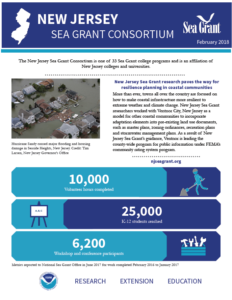
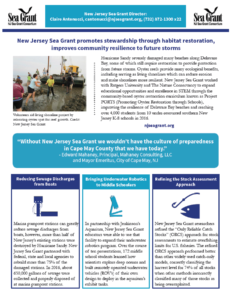
As an additional guide, please take a look at NJSGC’s year-in-reviewfact sheet developed by NOAA, and feel free to share!
We are forever grateful for your support and it is our pleasure to serve you.
In partnership with the NOAA Ocean Acidification Program and the Mid-Atlantic Sea Grant Programs, New Jersey Sea Grant is pleased to announce the availability of a new graduate research fellowship program in ocean, coastal, and estuarine acidification. Contingent upon available federal funding, we anticipate supporting approximately five (5) fellowships, one in each Mid-Atlantic state (NJ, DE, NY, VA, MD). Potential OA Fellows must already be enrolled in an accredited university and have an academic advisor who will act as the primary mentor for their education and research. Deadline to apply is 5:00 p.m. Friday, April 13, 2018.
For more information, please visit NJSGC’s updated list of current fellowships.
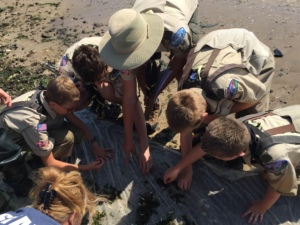
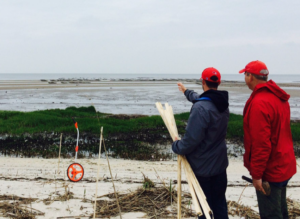
In this interactive one-day badge program at Sandy Hook, scouts will learn the basics of environmental science as we explore various aspects of the maritime environment. Through seining (net and boots provided), we will discover what lives in Sandy Hook Bay. Hiking through the Salt Marsh, we will learn about its ecology through birding, plant identification, tidal impacts, water quality testing, and conduct a vegetation survey. We will study the effects of pollution on various environments both at the beach and in the laboratory, including simulated oil spills and acid rain; and discover how waves and tides affect pollution. Scouts will learn about biodegradable materials. We will study ocean acidification and soil erosion effects and analyze an Environmental Impact Statement. Mandatory worksheets must be completed in advance, and a subsequent lab report must be submitted using data collected during this class.
The program runs approximately 5 hours and scouts will need transportation to the marsh site. Cost is $45/individual scout; accompanying adult is free. Program is scheduled for Sunday, May 6th from 10:00 – 3:00 pm. Open to all Boy Scouts. To register, please go to our website or contact NJSGC’s Scout Program Coordinator Jody Sackett at 732-872-1300, ext. 20.
Reminder: enrollment information for April’s Individual Oceanography Merit Badge Program is also available online.
In a fun “hands on” ocean experience at Sandy Hook, Boy Scouts can complete the Oceanography Merit badge in one day with the help of NJSGC Instructors who are Certified Merit Badge Counselors. Scouts will explore the salt marsh and discover why the ocean is important to people. Activities include measuring water quality, studying waves and currents, viewing worldwide sand samples under the microscope, plankton collection and identification, laboratory experiments, and seining in Sandy Hook Bay. Mandatory worksheets must be completed in advance of the program.
The program runs approximately 4 hours and scouts will need transportation to the nearby marsh site. Cost is $45/individual scout; accompanying adult is free. Program is scheduled for Saturday, April 28th from 10:00 – 2:00 pm. Open to all Boy Scouts. To register, please go to our website or contact NJSGC’s Scouts Program Coordinator Jody Sackett at 732-872-1300, ext. 20.
It is widely known as the “Garden State,” but with 130 miles of ocean beaches and 1,792 miles of tidal shoreline, New Jersey could just as easily have been the “Coastal State.” Seventeen of New Jersey’s 21 counties border estuarine or ocean waters. NOAA defines all but one of those counties as coastal, and, under Section 6217 of the Federal 1990 Coastal Zone Management Reauthorization Act, all of New Jersey is considered coastal since all of its watersheds drain to the coast.
New Jersey is home to a number of extraordinary demographics. While it is the fourth smallest state area-wise, it is the most densely populated one in the nation. Like many coastal states, New Jersey is highly dependent upon its coastal resources. In addition to its coastal tourism, boating, and recreational fishing industries, New Jersey is home to nine commercial fishing ports and two of the nation’s largest commercial shipping ports. The value of these industries is enormous, with ports commerce supporting a $50 billion industry, coastal tourism at $28 billion, and total sales revenue in commercial (including aquaculture) and recreational fisheries accounting at nearly $10 billion. More than 1.5 million individuals with per capita incomes among the highest in the nation depend on these coastal-dependent industries for their livelihoods. The coast is also a source of recreation for New Jersey’s nearly 9 million residents and the 91 million-plus potential visitors who live within a four-hour drive.
These competing uses have created intense competition for New Jersey’s coastal lands, waters, and resources. The state’s coastal communities face enormous pressure to balance demand for revenue and growth with protection of marine and coastal resources. In addition, because New Jersey’s coastline is heavily developed, human safety, protection of property, and coastal hazard mitigation are areas of ever-increasing concern. Balancing economic growth, development, and redevelopment, with coastal resource quality and human safety is the critical issue for the future of New Jersey’s coastal communities.
Science-based management and effective public policy are essential to ensuring human health and safety and to preserving New Jersey’s ecological services and economically essential uses. Through this plan, NJSGC renews its commitment to advance knowledge and stewardship for New Jersey’s marine and coastal environments and provide New Jersey’s citizens, stakeholders, and policymakers with a trusted source of sound, unbiased, and evidence-based information and technical assistance to help them make well-informed decisions and take appropriate actions affecting the future of the state’s coastal resources and all who depend on them.
This plan aligns with the National Sea Grant College Program’s 2018- 2021 Strategic Plan and is organized in accordance with its four focus areas: Healthy Coastal Ecosystems, Sustainable Fisheries and Aquaculture, Resilient Communities and Economies, and Environmental Literacy and Workforce Development. The plan also affirms New Jersey Sea Grant Consortium’s support of the National Sea Grant College Program’s core values and cross-cutting principles while drawing on the unique strengths and abilities of NJSGC to address critical state needs.
The New Jersey Sea Grant Consortium recently announced its latest round of Sea Grant-funded research projects that are included in the program’s omnibus for 2018-2020.
As previously reported, NJSGC received a record-breaking number of research pre-proposals from a diverse array of institutions in early 2017, all seeking funding to conduct research to respond to the priorities identified in NJSGC’s most recent request for proposals. Of the 43 pre-proposals submitted, NJSGC’s Technical Review Panel (TRP) recommended that 17 move forward to the final round of review. Full proposals were submitted in June and assessed until the end of the year.
During the rigorous review process, priorities for funding such research were determined through a collaborative process that received input from stakeholders, NJSGC’s advisory boards and partners, and several other objective specialists. The final projects were selected based on relevancy and scientific rigor using a competitive, peer-reviewed evaluation. As a result, the select projects chosen for funding reflect local concerns and seek solutions to New Jersey’s most pressing marine and coastal issues. The current cycle covers a wide range of topics, including:
While these projects span a variety of topics, they all contribute towards NJSGC’s mission to provide sound scientific data to promote wise decision-making about New Jersey’s coastal and marine resources. Projects are funded in part through a grant from NOAA/National Sea Grant which NJSGC has successfully managed in the state of New Jersey since 1976.
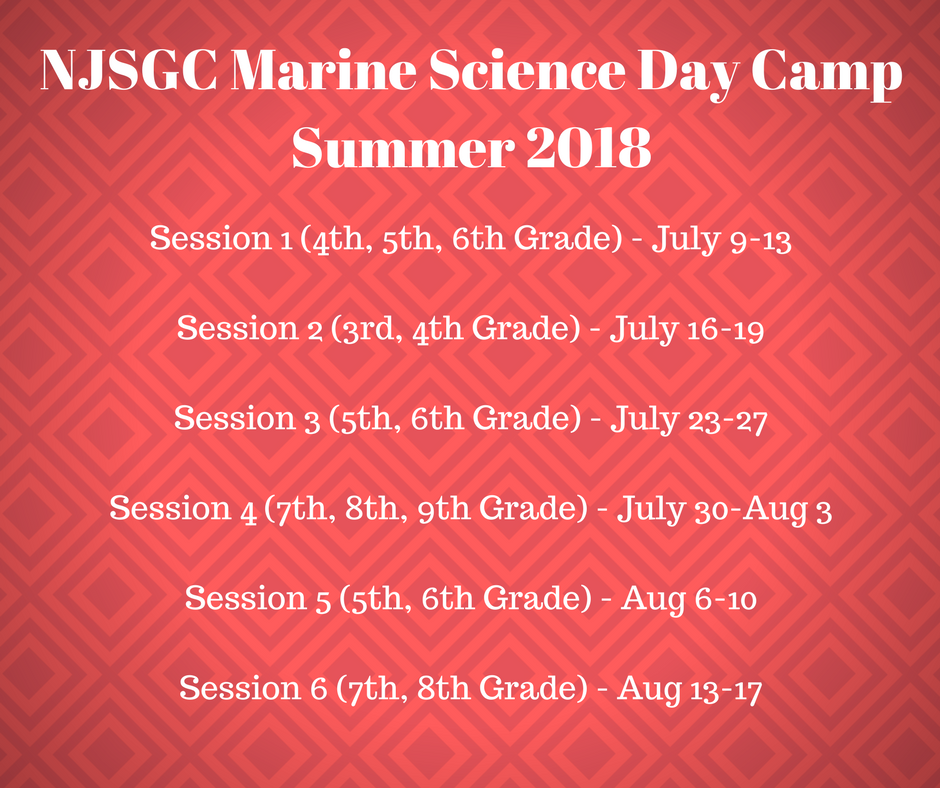
Marine Science Day Camp at the New Jersey Sea Grant Consortium offers “hands-on” science learning for children interested in the ocean and marine life. Camp is held on Sandy Hook and combines outdoor explorations of the beach and bay with laboratory experiments and fun, educational games and crafts. Instructor to camper ratio is 1 to 6. The six updated sessions for 2018 are now listed below.
Please note that sessions are geared towards specific grade levels. For more information on the focus of each session, click here. Contact Rose Higgins at 732-872-1300 x19 to reserve a spot for your student today!
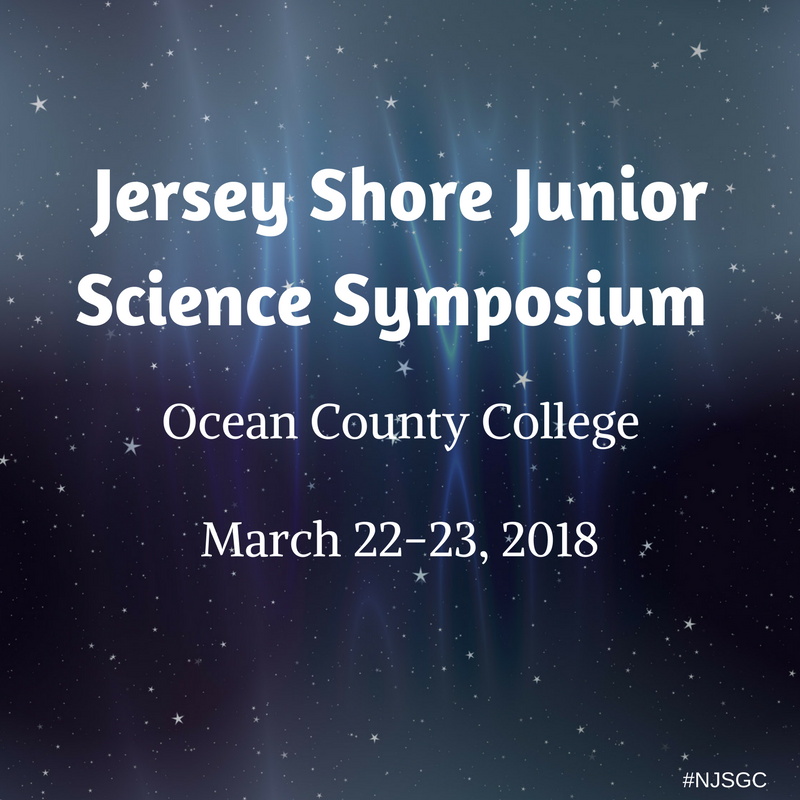
The Jersey Shore Junior Science Symposium will be held March 22-23, 2018 at Ocean County College in Toms River, NJ.
JSJSS is designed to challenge, engage, and publicly recognize students (Grades 9-12) conducting research in the sciences, technology, engineering, or mathematics (STEM). The Army will sponsor five topic areas during the 2018 event:
Best in Nanotechnology & Advanced Materials Science (Additive Manufacturing) Best in Robotics Best in Computing, Computer Science, and Engineering Best in Aerospace and Astrophysics Best in Environmental and Earth Sciences
Finalists will compete for several extensive awards, including a $300 (first place) scholarship from the NJSGC.
Fore more information, please visit the official JSJSS website.
Registration is now CLOSED, but we strongly encourage teachers and students to attend as spectators. Please refer to the summary page or email sjjss@ocean.edu for more details and consideration.
The NOAA/Sea Grant Coastal Management and Digital Coast Fellowship provides two years of on-the-job education and training in coastal resource management and policy for postgraduate students. The program matches postgraduate students with state coastal resource agencies and nonprofit organizations to work on coastal projects proposed by state officials and selected by the NOAA Office for Coastal Management. Deadline to apply is January 19, 2018. For general information on the Coastal Management and Digital Coast Fellowship go to: http://coast.noaa.gov/fellowship/. Also view the updated ‘digital coast’ announcement here.
Former NJSGC associate Jackie Specht was recently awarded the Coastal Management Fellowship and matched with Maryland’s Chesapeake and Coastal Service to continue studying the beneficial reuse of dredge material.
The NOAA/Sea Grant John A. Knauss Marine Policy Fellowship matches graduate students interested in ocean resources and the national policy decisions affecting them with “hosts” in the Washington, D.C. area for a one-year paid fellowship. Any student, regardless of citizenship, is eligible if enrolled towards a degree in an accredited graduate program. Interested applicants must apply through their local Sea Grant Program. New Jersey applicants are strongly encouraged to reach out to Dr. Peter Rowe or Ms. Claire Antonucci a minimum of one month prior to the state application deadline to provide notification of their intent to apply and request application support. Applicants should also allow sufficient time to schedule an interview at the program’s request. The state application deadline for New Jersey students to submit their final application package to NJSGC is February 23, 2018, 5pm local time. For more information on the Knauss Fellowship go to: http://seagrant.noaa.gov/Knauss.
The NOAA Fisheries/Sea Grant Joint Graduate Fellowship Program in Population and Ecosystem Dynamics and Marine Resource Economics is designed to strengthen the collaboration between Sea Grant and the National Marine Fisheries Service (NMFS). The Fellowship is available to US citizens who are graduate students enrolled in PhD degree programs in academic institutions in the United States and its territories. Fisheries Fellows will work on thesis problems of public interest and relevance to NMFS at participating NMFS Science Centers or Laboratories under the guidance of NMFS mentors. Deadline to apply is January 26, 2018. For general information on the NOAA Fisheries/Sea Grant Fellowships go to: http://seagrant.noaa.gov/NMFS-SG-Fellowship.
Read more about these fellowships and how to apply here.
NOAA Sea Grant and National Marine Fisheries Service (NMFS) are pleased to once again be partnering together for the NMFS-Sea Grant Joint Fellowship program. Two federal funding opportunities (FFO) are currently open to applicants seeking funding beginning in 2018.
The NMFS-Sea Grant Joint Fellowship program supports students pursuing doctoral degrees in population and ecosystem dynamics as well as marine resources economics. The program is a focused workforce development effort to train highly qualified professionals for NOAA’s science-based approach to fisheries management.
Since its inception, the joint fellowship program has supported 81 population and ecosystem dynamics students and 32 marine resource economics students. About 40% of the alumni now work for NOAA.
For more information and details on applying, please click here.