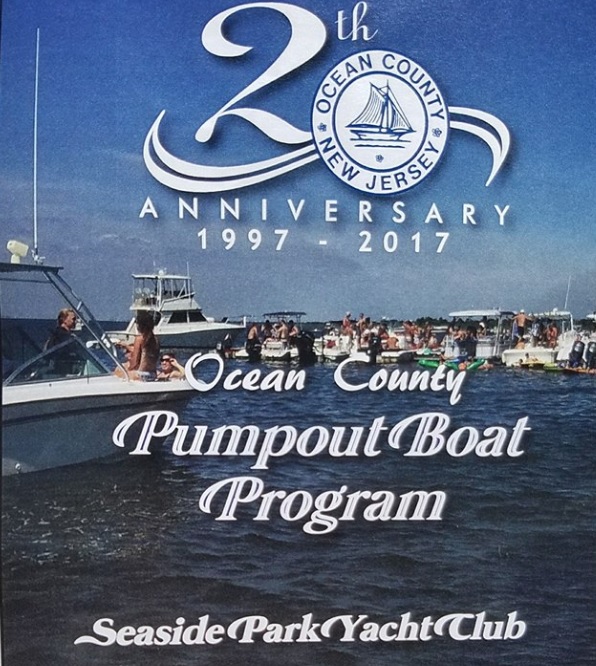
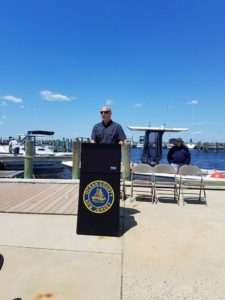
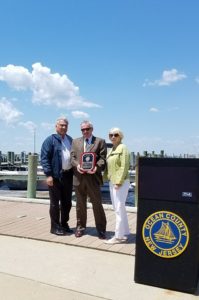
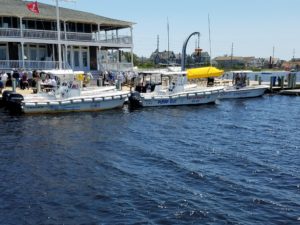
June 2017 – On Friday (June 2nd), the New Jersey Clean Vessel Act Program joined in celebrating Ocean County for successfully operating its growing fleet of pumpout boats over the last 20 years. Such significant contributions have helped improve water quality throughout Barnegat Bay and Little Egg Harbor for the past two decades.
The New Jersey Sea Grant Consortium was represented at the Seaside Park Yacht Club by Assistant Director of Extension and the Marine Recreation Agent of Fisheries & Boating, Michael Danko.
The federal Clean Vessel Act was passed 26 years ago, thanks to the New Jersey Department of Environmental Protection/Division of Fish & Wildlife for requesting and managing the approval of such federal funds. State funds are also provided by “Shore Protection” license plate sales.
The New Jersey Clean Vessel Act Program now operates as a partnership among the Division of Fish & Wildlife, the Monmouth County Health Department, the Marine Trades Association of New Jersey, the New Jersey Sea Grant Consortium, and Ocean County Planning Department (plus additional public and private entities).
Ocean County Department of Planning Director David J. McKeon was also recognized during the ceremony for such achievements.
Despite initial hurdles and reservations, the program’s first pumpout was successfully installed at Green Cove Marina located on the Metedeconk River. Nowadays, the approval, purchasing, and maintenance procedures for additional fleets run rather smoothly (with a current total of six operating boats). Services are offered free of charge.
The ongoing success of the Ocean County Pumpout Program relies heavily on partnerships with Ocean County Board of Chosen Freeholder, Ocean County Planning Department, Ocean County Utilities Authority, Township of Brick, Borough of Seaside Park, Tuckerton Seaport, and the dedicated pumpout boat captains.
We wish the Ocean County Pumpout Program and all associates a very successful future in providing such phenomenal pumpout boat services.
For additional information, please visit the Ocean County Department of Planning website.
Learn more about the Clean Vessel Act Program here.
Please accept our sincerest appreciation for your support of Sea Grant and the New Jersey Sea Grant Consoritum. Earlier this spring, you reached out to your elected officials to tell them why Sea Grant is important to you and our state. Your efforts resulted in Congress and the President signing off on a budget for FY 2017 that includes adequate funding for us and the entire Sea Grant Program. For the rest of this fiscal year, this funding will enable our program to work with you on important issues including stormwater management, increasing coastal resilience, supporting shore tourism, and providing STEM education for youth, all to benefit New Jersey’s coastal economy and communities.
The Administration has just released its FY 2018 budget blueprint. It proposes the termination of the entire Sea Grant program. Once again, we must repeat our request to you to reach out to your elected officials as soon as possible to reiterate your request that they let the House and Senate Commerce, Justice, and Science Appropriations Subcommittees know of their strong support for Sea Grant, to reject the proposal to terminate the program in FY 2018, and instead fund the National Sea Grant College Program at $80 million.
When you write or call your elected representatives it is important to tell them why the program is important to you and our state’s environment and/or how our work has benefitted you personally.
To help you develop your message, we have included a template for possible use in composing your message.
To further assist you, this directory includes each of New Jersey’s elected officials, including email addresses for their aides. If you decide to write, please direct your letters to local offices (not DC). If you decide to call or fax, it is best to call both the local and Washington D.C. offices. If you decide to email, please write your message to your elected official but use the email address provided in the directory for his or her aide.
You can also locate your Senators and Representatives at https://callyourrep.co/ or text your home address to 520-200-2223 and you will receive a message containing the names and phone numbers of your representatives.
Thank you again for your ongoing support and effort.
Rally for the Navesink seeks to reduce river pollution and to instill community-wide “watershed mindfulness.” The Rally utilizes a grassroots approach to help track down sources of pollution while fostering collaborations with several talented groups throughout the 95 square mile watershed, including ongoing support from state and local elected officials and agencies.
The next phase of pollution track down is underway. Clean Ocean Action, in partnership with the NJ Department of Environmental Protection (NJDEP) and the Navesink River Municipalities Committee, seeks citizen volunteers to partake in a citizen science water quality sampling program in the Navesink River watershed. Sampling will focus on the microbial source tracking under ambient conditions.
This is part of the “Find It and Fix It” approach of the Rally for the Navesink:
Seventeen locations have been identified (four-five per town) in Tinton Falls, Red Bank, Middletown, and Fair Haven
Required time is Wednesday mornings between 8am and 10am
The sampling technique is basic and straight-forward, but training is required
The entire sampling process, including pick-up and drop-off, is approximately an hour
Volunteers will pick up and drop off sample bottles from designated locations within the watershed
The duration of this entire testing program is 52 weeks. However, the frequency of each volunteer’s involvement depends on many factors, such as total number of volunteers
All volunteers must attend at least one training session (conducted by NJDEP staff) where they will learn the protocol required for sampling. Such training is mandatory for all volunteers:
May 24, 2017, 6:00 pm at Red Bank Public Library (followed by field visit to a nearby location)
May 25, 2017, 5:30 pm at Bingham Hall (followed by regular Rally meeting at 6:30pm)
If interested, please contact Mae Henry, Marine Program Associate at Clean Ocean Action, for more information – email outreach@CleanOceanAction.org or call 732-872-0111.
Learn more about Rally for the Navesink here. Also visit their official Facebook page.
Rally for the Navesink is an alliance of groups coordinated by Clean Ocean Action (COA): American Littoral Society ~ Bayshore Anglers Association ~ Bayshore Regional Watershed Council ~ Conserve Claypit Creek ~ Hartshorne Woods Association ~ Monmouth Boat Club ~ Monmouth Conservation Foundation ~ Navesink Business Group ~ Navesink Maritime Heritage Association and River Rangers ~ Navesink Shrewsbury River Fishing Club ~ Navesink River Rowing Club ~ NJ Friends of Clearwater ~ NY/NJ Baykeeper ~ Oceanport Water Watch Committee~ Oceanic Free Library ~ Pirates Care ~ Recreational Fishing Alliance ~ Red Bank Business Alliance ~ River Rats ~ Riverview Medical Center ~ Rumson Garden Club ~ Shrewsbury Sailing & Yacht Club ~ Sierra Club-Shore Group ~ Surfrider-Jersey Shore Chapter
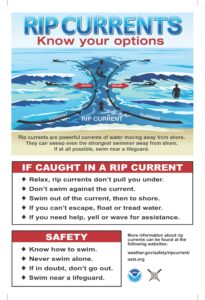
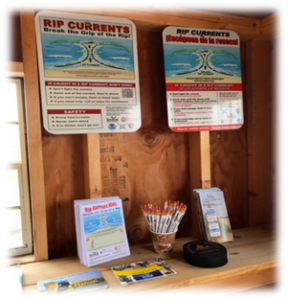
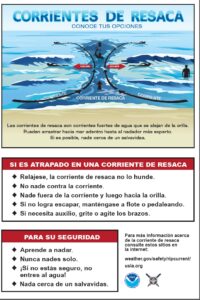
The Extension Program manages a comprehensive Rip Current Awareness campaign for New Jersey which includes producing and distributing thousands of metal signs in English and in Spanish, warning swimmers about the danger of rip currents and illustrating what to do if caught in one.
The signs are posted at high-traffic beach access and bathing points in essentially every shore community along the New Jersey coast. Rip Current Awareness brochures are distributed at municipal buildings, beach badge check-points, and other strategic locations from Sandy Hook to Cape May. The initial Rip Current Awareness project was a partnership effort between NJSGC and the NJDEP, NJDOT, NJ Travel and Tourism, NOAA-NWS, and the NJ State Police OEM.
Municipal officials interested in obtaining additional signs in English and Spanish or copies of NJSGC’s rip current safety trifold brochure, please contact the New Jersey Sea Grant Consortium at 732-872-1300 ext 10.
Please visit the National Weather Service website for all updated safety signs, multimedia, and handouts related to Rip Current Awareness.
Any municipality or organization interested in arranging for a speaker or special presentation about rip currents for workshops, conferences, or public meetings can contact Dr. Jon Miller.
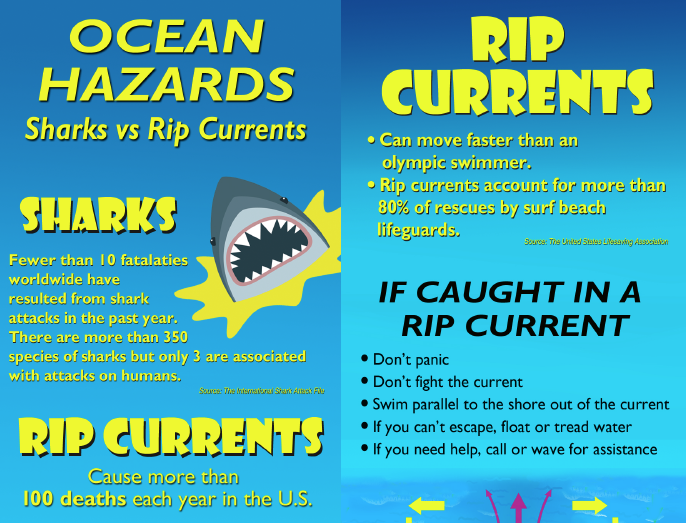
A unique Jeopardy-style trivia game entitled “Sharks vs. Rip Currents” was specifically designed to educate children about the dangers of changing currents. Thousands of bookmarks inspired by “Sharks vs. Rip Currents” have been distributed to young beachgoers throughout the Jersey Shore area, with fun and easy-to-remember facts about safe and smart ocean swimming. Please contact us for more information. And be sure to always remember, “When in doubt, don’t go out!”
NJSGC is pleased to offer our popular “Ocean Hazards and Beach Safety” program virtually in Spring 2022. This FREE presentation was made possible by the generous support of Investors Foundation, the charitable institution of Investors Bank. Click here to read more.
Please accept our sincerest appreciation for your support of Sea Grant and the New Jersey Sea Grant Consortium. Earlier this spring, you reached out to your elected officials to tell them why Sea Grant is important to you and our state. Your efforts resulted in Congress and the President signing off on a budget for FY 2017 that includes adequate funding for us and the entire Sea Grant Program. For the rest of this fiscal year, this funding will enable our program to work with you on important issues including stormwater management, increasing coastal resilience, supporting shore tourism, and providing STEM education for youth, all to benefit New Jersey’s coastal economy and communities.
The Administration has just released its FY 2018 budget blueprint. It proposes the termination of the entire Sea Grant program. Once again, we must repeat our request to you to reach out to your elected officials as soon as possible to ask for their ongoing support of the Sea Grant program.
When you write or call your elected representatives it is important to tell them why the program is important to you and our state’s environment and/or how our work has benefitted you personally.
To help you develop your message, we have included a template for possible use in composing your message, which you can find below.
To further assist you, this directory includes each of New Jersey’s elected officials, including email addresses for their aides. If you decide to write, please direct your letters to local offices (not DC). If you decide to call or fax, it is best to call both the local and Washington D.C. offices. If you decide to email, please write your message to your elected official but use the email address provided in the directory for his or her aide.
You can also locate your Senators and Representatives at https://callyourrep.co/ or text your home address to 520-200-2223 and you will receive a message containing the names and phone numbers of your representatives.
HOW TO VOICE YOUR CONCERN FOR THE NATIONAL SEA GRANT PROGRAM AND THE NEW JERSEY SEA GRANT CONSORTIUM
(To follow is a sample letter that may help you prepare your own message to our Senators and Representatives. Thank you for your support!)
To the Honorable (insert your Senators or Representatives last name here):
I have recently learned that the President’s FY 2018would terminate the National Sea Grant College Program (Sea Grant). As one of your constituents, and as a beneficiary of the New Jersey Sea Grant Program, I respectfully urge you to reject this proposal and support the continuation of the Sea Grant Program.
Sea Grant program is a joint federal-state investment that supports the health and resilience of the Nation’s coastal communities. The program yields quantifiable economic, social, and environmental benefits at the national, regional, state, and local level. Sea Grant is unique within NOAA in that it sends 95% of its appropriated funds to states including New Jersey where it is used to solve problems identified as locally critical by public and private stakeholders and coastal communities.
In 2016 Sea Grant helped generate an estimated $575 million in economic impacts; created or sustained nearly 21,000 jobs; provided 33 state-level programs and 534 communities with technical assistance on sustainable development practices; worked with about 1300 industry, local, state and regional partners; and supported the education and training of almost 2000 undergraduate and graduate students. The Sea Grant program achieved this with a Congressional appropriation in FY 2016 of $73 million, which is leveraged with matching funds provided by states, universities, and other sources.
(At this point, please consider writing about the program from your own personal standpoint, or delete this section before sending your message. You may want to talk about your experience with New Jersey Sea Grant, how you have benefitted from the program, how the state benefits from the program, how your institution, community, or students have benefitted, etc. You may also use, delete, or modify the text to follow as you see fit.)
What would the end of Sea Grant mean for New Jersey? Here are just a few consequences:
Nearly 25,000 New Jersey schoolchildren and thousands of teachers and youth leaders who depend on New Jersey Sea Grant Consortium for marine and environmental science education would lose the resource;
Research projects at New Jersey’s colleges and universities that respond to the needs of New Jersey’s coast and coastal economy would not occur. Currently NJSGC-funded research supports 42 scientists and 73 students at 8 different New Jersey facilities;
Dozens of community-based projects would end. These include beach and dune projects, flood prevention and living shorelines initiatives, rain gardens and other green infrastructure projects that improve water quality and quantity, repair of pump-out facilities at marinas statewide, and assistance to New Jersey’s growing shellfish aquaculture industry;
Another Fort Hancock historic structure, currently maintained and used by New Jersey Sea Grant as its headquarters, would be abandoned.
Please do not allow this important, highly effective program to be terminated.
I am grateful for your support of the Sea Grant Program including New Jersey Sea Grant thus far, and I thank you in advance for your continuing attention and support.
Sincerely,
(Be sure to include your home address along with your signature)
All of us here at NJSGC thank you again for your support and activism! For more information, please contact NJSGC Communications Specialist, Danica Bellini.
The National Sea Grant College Program has spent the last year recognizing its 50th anniversary. Each month, Sea Grant programs across the country have worked together to create content to highlight Sea Grant successes with a monthly theme.
January’s theme was “K To Gray” education. New Jersey Sea Grant Consortium’s education program holds a wide variety of programs directed towards advancing greater understanding and stewardship of our state’s marine and coastal resources. Collectively, these programs engage a large and diverse audience of learners. Our K-12 field trip program alone provides instruction to over 20,000 school children annually, taking them out of the classroom and onto the beaches, bays, and estuaries of New Jersey for active learning experiences.
To highlight these programs, the Consortium contributed an article on everything from summer camp to underwater exploration to be featured on the National Sea Grant homepage. The Consortium is also featured in an interactive story map covering education programs across Sea Grant’s entire network of coastal and Great Lakes states.
Check out the story map and read the article below to see how Sea Grant educators work in New Jersey and across the 33 other Sea Grant programs.
If it is summertime, you can be pretty sure that most New Jersey residents have plans to make it to the beach. And with so many miles of wonderful coastline, why wouldn’t they? Whether it’s for a day trip or a whole week, New Jersey beaches are prime locations for summer fun in our great outdoors.
This poll was created in 2008 as the New Jersey’s Top Ten Beaches Survey to encourage stewardship and pride in the state’s beaches while promoting a little healthy competition between New Jersey’s favorite beach towns. It is a way to celebrate everything there is to love about the Jersey Shore. We’ve conducted this poll since 2008 to call attention to New Jersey’s amazing beaches. Over time we’ve learned a thing or two — mostly that New Jerseyans are passionate about all the beaches up and down our coast. So, in order to better recognize every inch of our wonderful coastline, this year we will recognize a number one beach in each of New Jersey’s four coastal counties as well as a favorite beach overall.
This year after nearly 10,000 votes cast in a public poll, New Jersey Sea Grant Consortium revealed the winners in Ocean City, the defending champion of the poll.
Update 7/19/2016: There is now an updated version of the Dune Manual available at njseagrant.org/dunemanual
FORT HANCOCK — Backed up by the latest research, best practices for dune restoration have changed dramatically in 30 years, which is why the New Jersey Sea Grant Consortium and its partners wants the Jersey Shore to Dune it Right.
The last manual providing instructions about how to restore dune ecology was published by the USDA Plant Materials Center in the 1980s, and much of that advice is obsolete.
At the time, the key to dune restoration was American beachgrass.
“We see people planting Ammophila breviligulata — beachgrass — everywhere,” said Dr. Louise Wooton, of Georgian Court University at a recent outreach workshop on dune restoration and storm surge.
Beachgrass is still vital to dunes, but more emphasis is being placed on the diversity of plant species, but also of the grass itself. Nearly all the grass in dune restorations is from one Cape Cod-based variety, according to research by Dr. Michael Peek . Researchers say that needs to change if the dunes are to become more resilient.
With support from the NOAA National Sea Grant Office, New Jersey Sea Grant Consortium and its partners are correcting and updating those instructions through the Dune it Right Manual, published on njseagrant.org.
Dr. Amy Williams of Stevens Institute of Technology will present Dune it Right at the American Shore & Beach Preservation Association later this month. Click here to learn more.
The manual is a living document written by researchers and extension agents at William Paterson University, Stevens Institute of Technology, Georgian Court University — all NJSCG members — and USDA Natural Resources Conservation Service Plant Materials Center at Cape May who have had dune and beach research funded by the consortium.
Coastal experts wrapped-up a round of workshops aimed at developing an understanding of storm surges and dune restorations last month. The latest round was the second time this year that workshops were held to publicize the dune manual and update stakeholders about the latest best practices and research in dune management and restoration.
Here’s a breakdown of some recommendations:
Don’t plant beachgrass in rows, attempt to plant in circles instead.
Try to plant beachgrass
Know the habitats: Dune ecology changes rapidly going inland. What one species likes on the primary dune, isn’t necessarily going to work for them on a secondary dune.
In built out communities, treat yards and garden spaces as secondary dunes or maritime forests, and select native plant species that thrive in back dune environments.
Make dunes diverse environments. Don’t just plant one species of plant.
The first round in the spring were aimed specifically at government officials who might be managing public dune restorations. seminars were held in each of the state’s four coastal counties.
The second round, one held in Cape May and the second held in Surf City on Long Beach Island were open to the general public.
Dunes, and their protective power, were proven to be a vital assest to beach communities during the onslaught of Hurricane Sandy. Communities without dune protection, by and large, fared much worse if they had no protection. The protective power of dunes is, in part, why dunes and beaches are considered to be the Garden State’s most valuable ecosystem.
Intense development along the Jersey Shore and the heavy use of the beaches by humans has reduced most of the dunes and the ecological services they provide, especially wrack lines, secondary dunes and maritime forests.
This has been done to make the beach “clean” and easy to access, experts said.
State and federal parks and reserves, and a few communities like Avalon in Cape May County Bradley Beach in Monmouth County are exceptions.
“Bradley Beach made a committment in the 1980s to build dunes,” Wooton told the crowd at Long Beach Island. “For 30 years, without any major storms they may have looked pretty silly, but than Sandy hit and they don’t look silly anymore.”
The Dune It Right manual can be downloaded at by clicking here.
The Army Corps of Engineers completed work on the first phase of a $105 million storm resiliency and flood mitigation project in the Port Monmouth section of Middletown Township, according to a report in the Asbury Park Press. But the project will present new challenges, according to a New Jersey Sea Grant Consortium and Monmouth University expert.
The $17.7 million first phase was reportedly in development for years before the storm, but the damage sustained to the small bayside community in the aftermath of the tempest made completion of the project a priority.
Port Monmouth is a small peninsula. To the north of the 3,800-person community is Sandy Hook Bay, to the west and east are Pews and Compton creeks and their respective salt marshes. The Superstorm Sandy surge and tidal flooding reportedly damaged 750 homes. The community had 1,441 housing units, according to the 2010 census.
“Being that the project was in the pipeline for the past couple of decades, it can be seen as a worthwhile venture,” said Dr. Michael Schwebel, reacting to the report. “It is well-rounded and holistic in that it will address the Sandy Hook Bay and back creek flooding through tide gates, levees, and water pumping stations.”
Schwebel is the community resilience and climate adaptation specialist for NJSGC and Monmouth University’s Urban Coast Institute.
In the first phase, sand dunes were built 13 feet above sea level to provide storm surge protection, 400,000 cubic yards of sand was placed along Monmouth County’s Bayshore Waterfront Park and a stone groin that extends 300 feet into Sandy Hook Bay was built. Additionally, the Port Monmouth fishing pier was extended 195 feet into the bay.
Related: NJSGC Dune It Right Manual is a guide to dune restoration: click here.
“These are the types of projects that will help alleviate some of the flooding, surge, and overall impact of storm events and impacts of sea-level rise,” Schwebel said. “However, like the article stated, this is only Phase 1. This project is only focused on water coming in from Sandy Hook Bay and the future phases will help to solidify the resilience of Port Monmouth.”
FORT HANCOCK — Michael Schwebel has joined New Jersey Sea Grant Consortium and Monmouth University’s Urban Coast Institute as their community resilience and climate change adaptation specialist. The position, created by the partners following Superstorm Sandy, aims to increase the resilience of New Jersey’s coastal communities to future storms, flooding and the impacts of climate change.
“I look forward to sharing innovative approaches and unique knowledge and expertise to help communities plan and become better prepared,” he said. Read More …