Meet NJSGC’s Finalist for the 2026 John A. Knauss Marine Policy Fellowship
New Jersey Sea Grant Consortium’s applicant, Teemer Barry, has been selected as a 2026 Sea Grant Knauss Marine Policy Fellow!
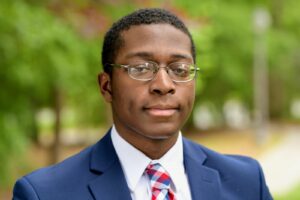
Teemer Barry, NJSGC’s 2026 John A. Knauss Marine Policy Fellow
Teemer is one of 48 finalists chosen nationwide for this highly competitive fellowship, which places early-career professionals in legislative or executive branch offices in Washington, D.C., where they contribute scientific and technical expertise to federal policymaking on marine, coastal, and Great Lakes issues. Teemer officially began the fellowship in June 2026 as part of Sea Grant’s 47th Knauss Fellowship class. Teemer is working at the National Centers for Coastal Ocean Science (NCCOS), which is part of NOAA’s National Ocean Service (NOS), and will be sharing updates throughout his time there.
Learn more about Teemer with his Q&A:
- Can you tell us a little about yourself?
I am a geoscientist studying at Rutgers University – New Brunswick, having previously graduated from the University of Maryland Eastern Shore. Most of my life prior to the beginning of my academic career had been spent in Durham, North Carolina, where my father’s incredible interest in permaculture, alongside my mother’s involvement with North Carolina’s legislative and socioeconomic proceedings, developed within me a great love for the promotion of appropriate land use practices and stewardship.
- What inspired you to apply for the Knauss Fellowship?
My motivation for participating within the Knauss Fellowship stems from a deep-seated drive towards environmental stewardship and justice. Long before my career aspirations had so firmly consolidated, I had wanted to participate in community, state, and federal-level organizations that promote the appropriate care and use of the environment in ways that can sustain humanity into the far future. I see the Knauss fellowship as perhaps the most direct pathway to apply a strong research background, like the one I have developed, directly into the national stage.
There was no singular event or mentor that urged my participation in the Knauss fellowship program as much as a cumulative series of discussions with all of the mentors that I hold most dear that urged me to consider not specifically the world I wanted to serve as much as the world that I wanted to create. I have always had a comfort mediating debates and speaking to diverse audiences, perhaps even more than the comfort I have with my own research, and so with the looming timeline of graduation and uncertainty in the future I chose to aim for the Knauss fellowship.
- How did your academic and research experience prepare you for this opportunity?
Are there any specific projects, skills, or lessons that proved especially valuable during the application process?
My academic career, especially within the last 5 years, has done exceptionally to prepare me for this opportunity (in my opinion). Since the beginning of my academic career, I have worked to position myself as a two-fold biogeochemist, developing the ability to discern the causes of systemic shifts in gradients as well as how those shifts lead to further cascades, and a bulk-data analyst, honing my use of data work to visualize those trends for broad audience digestion. I would spend functionally each year between 2020 and 2025 working on several projects hand in hand with state and federal agencies on a bevy of topics from plankton population dynamics and historical range changes within species of interest to developing a climatology of coastal water quality. Each fellowship, internship, and project over these years has served to inform me of how research is performed throughout academic and governmental circles, how research at various levels is directly applied to legislative practice, and how the choices made at these levels cascade down into the lives of everyday individuals. My time within the Office of Protected Resources and the Protected Species Division line offices within the Northeast Fisheries Science Center will likely be the most valuable to participation within the Knauss fellowship as both directly involved my participation within regular strategy meetings, the frequent review of federal regulatory documents, and a direction of my efforts towards lasting documents as opposed to smaller iterative reports.
- How are you getting ready for this next step? Have you done anything to prepare for your year as a Knauss Fellow?
Preparations for this experience have largely centered around wrapping up my thesis, paying close attention to the direction of legislation to ensure I am well informed, and reviewing the last several state and federal reports that have been critical to my research efforts. It is my hope to become far more familiar with the grants and project management side of executive work as well as congressional committee structures and proceedings through the fellowship opportunity but there has so far been no news as to how the cohort will be split. Until then, preparations have resembled a lot of report and transcript annotating.
- What are you most excited (or maybe nervous) about as you start the fellowship?
What do you hope to learn or experience?
I am most nervous about making the most of this opportunity. I am the type of person who thrives when given a desk, a stack of information to review, and the freedom to proverbially “dig in”. I think that the fact that this is a program that lasts for a single year while also being extremely competitive, nurtures split desires within me. For one, I want to prove myself. I want to use this opportunity to demonstrate that I can not only perform exemplary research on the national stage, but also that I can present outstanding arguments that can be recognized across political aisles for their virtue. In my head, this looks like an unflinching commitment to work as hard as I can every day and night to develop such an esteemed reputation. On the flip side, the program only lasts for a single year. Many opportunities for professional development, exploration, and even just simple personal enjoyment are likely to appear and I have worries that I may be too eager to let them pass me by in favor of a relentless commitment to what work is directly in front of me.
- Looking ahead, where do you see this experience taking you? Do you have any goals or aspirations for after your fellowship year ends?
I see two major benefits that may stem from my participation in the Knauss fellowship program. Firstly, I see the simple benefit of seeing how the legal sausage is made. I will be present at the nexus of decision-making and enforcement proceedings for the ways that the environment is used across our nation. This is an experience that I feel is almost necessary for anyone in my position or who carries my mindset of wanting to play an active role in how the place they live in executes on such negotiations. Secondly, I see the development of my mediating and negotiating muscles as an extreme benefit. Within my academic career, the justification of research as important or novel is performed through the extensive presentation of facts and associated logic that is tempered by colleagues and advisors into a finished and largely accepted product. I have little to no experience directly proposing my own work over someone else’s or prioritizing a particular line of questioning over another. While I am naturally prone to negotiation, I have no occupational experience where the quality of my work is measured in the decisive adoption of one practice over another. This extends into my hopes to learn more about the grants management lifecycle, as it is a line of work that has a great deal of influence over decisions that improve the day-to-day lives of others.
-
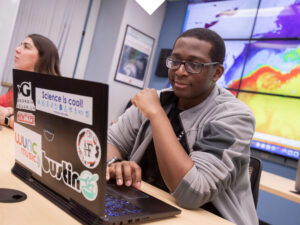
- Teemer Barry and Samantha Alaimo during a Rutgers Center for Ocean Observation Leadership (RUCOOL) photoshoot.
-
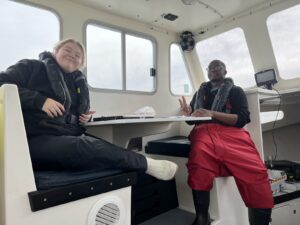
- Teemer Barry and a field researcher from Monmouth University during sampling in 2023.
-
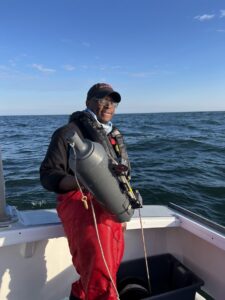
- Teemer Barry during a 2023 sampling event, holding a niskin water sampling device.