Girl Scout Badge Programs
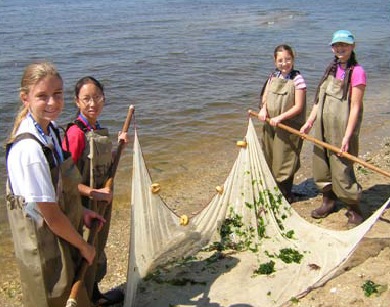
The New Jersey Sea Grant Consortium (NJSGC) offers a variety of marine science-based Girl Scout merit badge programs for all levels of scouting from Daisies through Cadettes. These programs are an opportunity to explore the marine environment in a fun and educational way while earning a badge. All programs are held at Sandy Hook; some are indoor programs and can be done during the winter, while others are outdoor-only programs. Programs are led by experienced NJSGC environmental educators. Equipment and materials are provided by the NJSGC, and registration is required. Daisy programs last 1.5 hours; all other scout programs (except Journeys) are 2 hours.
For more information or to book a Girl Scout badge program, please contact Jody Sackett at 732-872-1300, ext. 20, or email JSackett@NJSeaGrant.org. Scout programs are reserved online: To register, select that option at the bottom of the main NJSGC Scout General Information Page and complete the application.
Daisy Rose Petals at Sandy Hook
Learn how to make the world a better place during this program. Through a scavenger hunt conducted in our laboratory classroom, girls will discover what can be recycled, what can be composted, and how to read recycling codes. They will make a recycled jellyfish craft and go on a guided beach hike to conduct a mini beach cleanup. Girls will earn the Rose Petal in this program.
Daisy Clover Petals at Sandy Hook
Scouts will learn about using resources wisely as they play a recycling game, and they will learn about plastic recycling and microplastics. Girls will go on a guided beach hike and conduct a mini beach cleanup. Girls will make a recycling craft. Scouts will earn the Clover Petal in this program.
Daisy Journey: Between Earth and Sky
Scouts will explore the central elements of Size, Shape, Texture, and Color as expressed through science at Sandy Hook. In this program, taught both indoors and outdoors, we’ll begin in our laboratory classroom, as scouts learn about various seashells found on NJ beaches and the animals that make them. They will play stacking games with shells and make a pompom Shell Friend to take home. Scouts will do colorful textural shell tracings and paint seashells with paints made from nature to take home. They’ll conduct a matching activity with seeds and flowers. We’ll go on a Scavenger Hunt hike to the beach, where the troop will go seining/dip netting in the bay (equipment provided) to find sea creatures, and collect shells to take home. For the Take Action Requirement, the girls will do a mini beach cleanup. Scouts will complete the Earth and Sky Journey in this 3-hour program.
Brownie Hiker at Sandy Hook
Get ready for an amazing coastal adventure! We start in our laboratory classroom where we learn how to make and interpret trail markings from shells, twigs, and rocks. We will hike from Fort Hancock, through the maritime forest and historical sites to the Sandy Hook beach. Scouts will do a Scavenger Hunt that helps them identify and explore this seashore environment full of marine creatures, unique plants, and fascinating shells. Girls will earn the Hiker Badge in this program.
Brownie Letterboxer at Sandy Hook
Letterboxing is an amazing adventure game played all over the world. During this program, scouts will create marine-themed Letterbox caches, which they will hide in secret outdoor places on Sandy Hook for their friends to then find through coded clues. Each girl will also make her own unique stamper to use (and keep) when finding letterboxes. Girls will earn the Letterboxer Badge in this program.
Brownie Home Scientist at Sandy Hook
Through everyday items, girls will learn the basics of science and how it’s applied to daily and marine life. The program is taught in our laboratory classroom, where we will explore the basic principles of magnetism, learn chemistry by combining kitchen ingredients to produce gases, discover density and salinity not only with common items but also how it applies to marine environments, and make beach sand “bubble up” as we explore climate change’s effects on our oceans. Scouts will make “Sed Balls” to take home and earn the Home Scientist Badge in this program.
Brownie Senses at Sandy Hook
Explore your five senses during this maritime adventure on Sandy Hook! The program is taught in our laboratory classroom, where we’ll touch live sea creatures from our aquariums, investigate unusual seashells, taste marshmallow “crabs,” explore the scents of Sandy Hook, learn to identify common animal calls, and design camouflage fish to hide in our laboratory classroom. Girls will earn the Senses Badge in this program.
Brownie Bugs at Sandy Hook
Marine bugs are fascinating creatures, and many different kinds call Sandy Hook home. Some live in the water or near the sand, and others, like Monarch butterflies, migrate right through Sandy Hook in the spring and fall. We’ll first learn about bugs in our laboratory classroom. Afterwards, we’ll hunt for marine bugs at the beach, seine fish in the Bay for aquatic bugs, and search along the edges of the salt marsh for migrating butterflies. Girls will make a Butterfly Waterer to take home and earn the Bugs Badge in this program.
Brownie Journey: It’s Your Planet, Love It! – Wonders of Water Journey
Girls will explore the properties of water and how important it is to our everyday lives and the environment around us. This interactive program is taught both outdoors and indoors. We will go seining (fishing net and chest wader boots provided) in Sandy Hook Bay to discover how water functions in the salt marsh and learn how to protect that delicate ecology. Girls will learn the science of water through various activities in our Laboratory Classroom, such as how a Watershed works with pollution runoff, what is Salinity, the Water Cycle, how to clean up a simulated marine oil spill, and about marine debris and microplastics. We will also explore how much water we use in everyday activities, and how much usable water there really is on Earth for us. We’ll practice conserving water through various activities, including a rain barrel system. This program covers the entire Wonders of Water Journey, so scouts just need to do their Take Action Project (suggestions provided) to complete the Journey (4-hour program).
Juniors Animal Habitats at Sandy Hook
In this popular program, Scouts will learn first-hand how marine creatures live at Sandy Hook beach and the salt marsh. We’ll start in our laboratory classroom, where girls can see marine animals living in our ten aquariums. Scouts will go seine fishing in the Bay to catch and observe marine creatures. We will discover secret clues about animal homes, and girls will make an animal house craft to take home. Scouts will earn the Animal Habitat Badge in this program.
Juniors Flowers at Sandy Hook
Scouts will study the science, usefulness, and beauty of classic flowers and native wildflowers at Sandy Hook. We begin in our laboratory classroom to learn the basic biology of flowers and pollination, as well as adaptation to harsh environments like Sandy Hook. Girls will create Victorian bouquets of various flowers to translate a secret message. They will learn pollinator strategies, use their creativity (and fragrances) to artistically create the ideal flower, and then play a game to see which ones actually get pollinated. We will make Seed Balls to take home. Girls will earn the Flowers badge in this program.
Junior Journey: It’s Your Planet, Love It!
This fun Journey focuses on the many aspects of energy: Girls will explore how important energy is to our everyday lives and the environment around us in this interactive program that is taught both outdoors and indoors. We’ll learn about potential and kinetic types of energy, from both active sources like coal and oil. In our Renewable Energy lab, we’ll learn about passive energy sources like wind, solar, wave, and bacteria. We’ll go seine fishing in the bay to collect creatures that use energy, including plankton, which we’ll examine under microscopes. We’ll play an outdoor game to learn how caloric energy is transferred within the food chain. In the laboratory classroom, we’ll learn about heat energy transfer, discover microplastics, play a marine debris biodegradation game, and explore alternative energy sources. This program covers the entire Get Moving! Journey, so scouts just need to do their Take Action Project (suggestions provided) to complete the Journey. 4-hour program.
Cadette Trees at Sandy Hook
Scouts will begin in our laboratory classroom by learning the biology of trees, leaves, and seeds. We’ll play a game to identify different types of trees, and learn about the many kinds of trees on Sandy Hook which can survive in the harsh seaside environment. Scouts will compare leaf structures under the microscope, listen to legends about trees, discover the usefulness of trees for food, shelter, animal habitats, and even Native American medicine and transportation. Girls will play a seed dispersal game to learn about nature’s various strategies. Scouts will hike through the maritime forest and do a classic tree sketch. Girls will earn the Trees Badge in this program.
Cadette Animal Helpers at Sandy Hook
Girls will learn how marine animals can help us directly, like rescue dolphins, and indirectly, through science. We’ll start in our laboratory classroom, where scouts will conduct their own animal behavior experiment using hermit crabs and snails, and learn about the beneficial Horseshoe Crab by holding baby ones. We’ll examine marine creatures under the microscopes, examining microscope crab slides. Scouts will go seine fishing in Sandy Hook Bay as “field biologists” to observe our animal helpers first-hand, and earn the Animal Helpers Badge in this program.