NOAA’s National Sea Grant Office anticipates approximately $1,000,000 of federal funds will be available to individual Sea Grant programs to support 1-5 projects that address Contaminants of Emerging Concern (CECs) across a shared geography, biogeography or watershed. Each application may request between $200,000 and $600,000 in federal funds per project and may be for up to three years.
Eligible Applicants
Sea Grant College Programs, Sea Grant Institutional Programs, and Sea Grant Coherent Area Programs are eligible to submit to this opportunity. Applications require the standard 50% non-federal match for Sea Grant projects. This will be a stand-alone (i.e., non-omnibus) award. All projects must take place within the United States or territories or their respective waterways.
Applicants are encouraged to pursue diverse partnerships, including with state agencies and academic institutions, to develop projects that research and monitor CECs that may cause ecological or human health impacts, including PFAS, in coastal and estuarine waters. Projects may include direct or competed research and appropriate associated supporting costs and activities (e.g., administration, extension, research/project synthesis) and could include efforts that:
Focus on species of ecological importance, particularly those with strong socio-economic and/or human health dimensions (e.g., subsistence, recreational, or commercial shellfish and/or finfish);
Focus on the prevalence, transportation, and biogeochemical transformations of CECs across a watershed or ecosystem, especially those with pathways that involve drinking water and/or wastewater;
Consider the in-situ multi-stressor and/or interactive effects of CECs that organisms likely experience in their natural environments; and/or
Perform short-term monitoring assessments to help steer more focused, long-term monitoring initiatives.
Applications must be submitted to Grants.gov by May 2, 2024.
If you have questions please contact Dr. Peter Rowe or sg.grants@noaa.gov and specify that your question is related to FY24 Contaminants of Emerging Concern in the subject line.
Subject to the availability of funding, the National Sea Grant Office (NSGO) anticipates approximately $1,000,000 in FY2024 federal funds will be available to eligible applicants to support 2-3 projects that will develop and execute local, regional and national programs, workshops and services to enable fishermen to enter career paths and make a living supplying seafood from our oceans, coasts and Great Lakes.
Awards will be made for no more than approximately $400,000 in federal funds per project, and may be for one or two years though for no more than $200,000 per year. Applications will require 25% in non-federal match funding. All projects must take place within the United States or territories or their respective waterways.
Successful projects will create and implement trainings that include the following types of programs, workshops, and services:
seamanship, navigation, electronics, and safety;
vessel and engine care, maintenance, and repair;
sustainable fishing practices;
other training needs as identified by the community.
There is no guarantee that funds will be available to make awards, or that any application will be selected for funding. If an applicant incurs any costs prior to receiving an award agreement signed by an authorized NOAA official, it does so at its own risk of not being selected or of these costs not being included in a subsequent award. NOAA and DOC will not be responsible for any incurred project costs if a project fails to receive full funding.
To be eligible to receive a grant under this program a recipient shall be a collaborative State, Tribal, local, or regionally based network or partnership of public or private entities, which may include— (A) a Sea Grant Institution; (B) a Federal or State agency or a Tribal organization; (C) a community-based nongovernmental organization; (D) fishermen’s cooperatives or associations; (E) an institution of higher education (including an institution awarding an associate’s degree), or a foundation maintained by an institution of higher education; or (F) any other appropriate entity.
Federal agencies and their personnel are not permitted to receive federal funding under this competition; however, federal scientists and other employees can serve as uncompensated partners or co-Principal Investigators on applications. Federal labs and offices can also make available specialized expertise, facilities or equipment to applicants but cannot be compensated under this competition for their use, nor can the value of such assets be used as match.
Applications must be submitted to Grants.gov by May 2, 2024.
If you have questions please contact Dr. Peter Rowe or sg.grants@noaa.gov and specify that your question is related to the Young Fishermen’s Career Development Projects in the subject line.
Check out some highlights from this edition of the COASTodian:
– Welcome to Dr. Roy Messaros to the NJSGC Extension Staff!
– An Interview with Oluwafemi Soetan
– Welcome to the Education Team Alaina Perdon
– NJSGC Educators Mindy Voss and Jody Sackett Present Microplastics Program at The Alliance for New Jersey Environmental Education Winter Research Symposium & Conference at TCNJ
Love what New Jersey Sea Grant Consortium does? We are currently hiring for 2 positions at our Sandy Hook office:
Communications Intern: NJSGC currently seeking a summer intern to work within the communications department and assist staff with all relevant tasks including social media campaigns, video production, event coverage/promotion, and programmatic outreach. This position is ideal for undergraduates interested in pursuing a career in the digital communications field, with a unique emphasis on marine, coastal, and STEM initiatives. The intern will report directly to NJSGC’s Communications Specialist and work throughout the busy 2024 summer season (May-August) at the Jersey Shore. Read the full job description here. Click here to view the full job description.
Field Instructor: The New Jersey Sea Grant Consortium (NJSGC), a non-profit organization on Sandy Hook, is hiring part-time field instructors for their K-12 Education Program and Scout Program. NJSGC provides students and scouts with dynamic ocean science programs that may include but not be limited to outdoor experiential learning activities such as seining, interactive games, scientific demonstrations and laboratory experiments. Join a great group of people that love the beach, the outdoors and sharing their knowledge with students to promote a love of environmental science. Gain hands-on educational experience and work in one of the most unique natural “classroom” environments in New Jersey, Gateway National Recreation Area-Sandy Hook Unit. Click here to view the full job description.
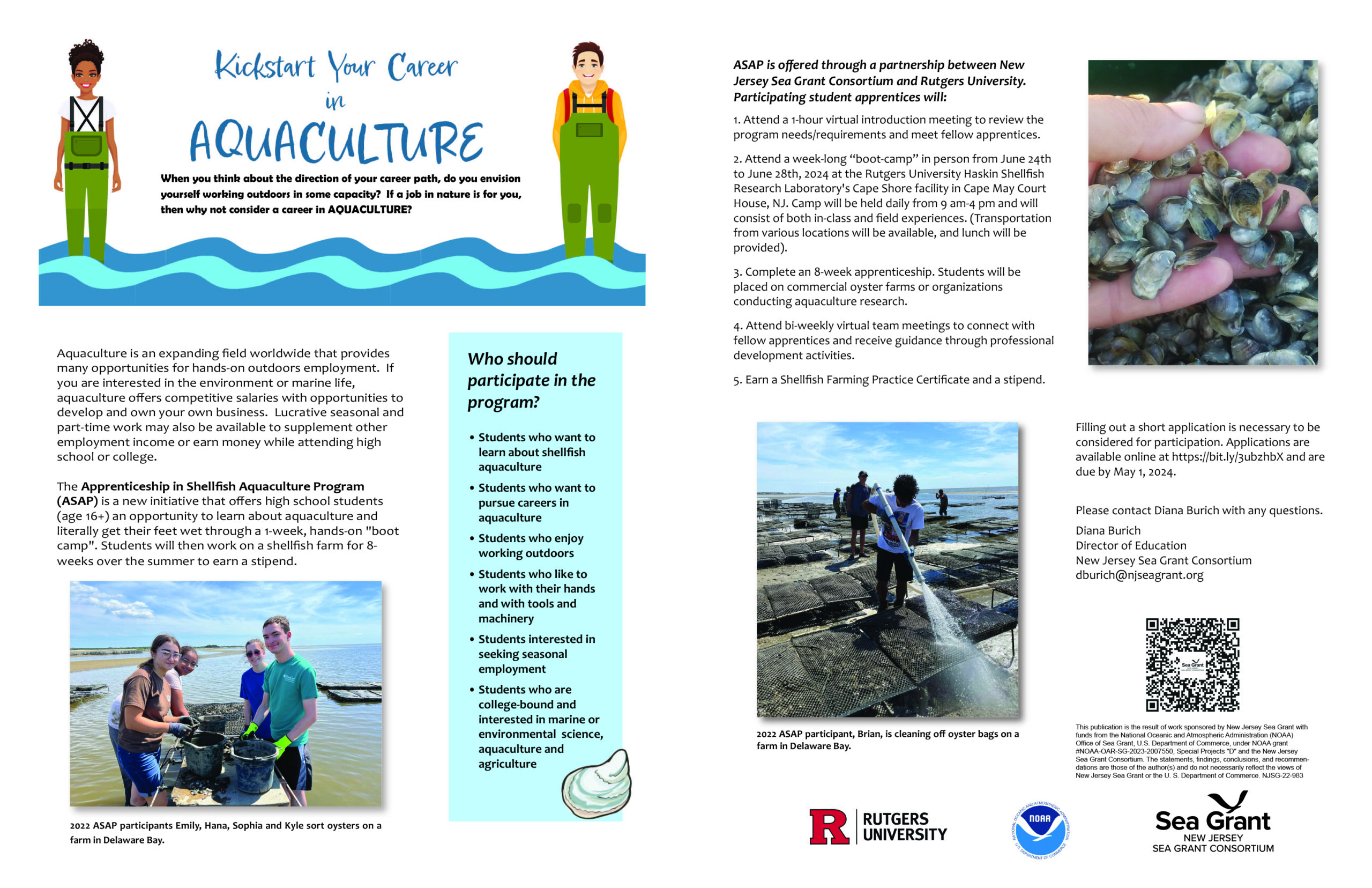
Apprenticeship in Shellfish Aquaculture Program (ASAP) is a unique new training concept for New Jersey high school students ages 16 and older to gain understanding about the aquaculture industry through education and practice. With a combination of in-person instruction and on-farm work experience, participants will discover the inner workings of shellfish aquaculture, gain entry level work skills, and learn what it takes to get food from the farm to our tables.
A collaboration of New Jersey Sea Grant Consortium, Rutgers University’s Haskin Shellfish Research Laboratory and industry partners, ASAP brings participants closer to the knowledge and understanding of shellfish aquaculture as one of New Jersey’s emerging industries that produces an important food source and contributes to coastal economies. The foundations of aquaculture science and technology are the heart of the program that incorporates industry practices and basic skills training with real-world experiences. Apprentices learn and gain valuable experiences with paid summer work, mentorship by program facilitators and industry professionals, and support from fellow participants.
Are you interested in joining a great group of individuals who want to learn more about aquaculture biology and technology and the opportunities in this fast-growing industry? Click here to learn more about the application. Applications are due May 1, 2024.
This project is sponsored by New Jersey Sea Grant Consortium with funds from the National Oceanic and Atmospheric Administration (NOAA) Office of Sea Grant, under grant #NOAA-OAR-SG-2023-2007550, Special Projects “D”.
Subject to the availability of funding, Sea Grant anticipates $5,000,000 to $6,000,000 will be available for research projects and programs that will develop and refine methods, protocols, techniques, and/or strategies to enhance the production of one or more life stages of aquaculture species (described below) with the overall goal of improving the efficiency, output, and profitability of commercial coastal, marine, or Great Lakes region aquaculture businesses.
Projects that focus on the following aquaculture categories and organisms in both marine and freshwater are eligible for this competition and include:
Microalgae and macroalgae (seaweed)
Molluscs
Crustaceans
Ornamentals
Baitfish
Finfish species for food production
Misc. invertebrates
Proposals are sought that will support broad, non-proprietary research to address issues and/or barriers to aquaculture production; make that information available to aquaculture businesses; and preferably include participation and involvement of Sea Grant extension personnel and industry stakeholders. All projects must take place within the United States or territories or their respective waterways.
This opportunity is open to: any individual; any public or private corporation, partnership, or other association or entity (including any Sea Grant College, Sea Grant Institute or other institution); or any State, political subdivision of a State, Tribal government or agency or officer thereof. Applications require the standard 50% non-federal match for Sea Grant projects.
Deadline for Letters of Intent: Wednesday, January 17, 2024 by 5:00 pm local time Deadline for full applications: Wednesday, April 3, 2024 by 11:59 pm ET
Subject to the availability of funding, Sea Grant anticipates $5,000,000 to $6,000,000 will be available for research projects and programs that will develop and refine methods, protocols, techniques, and/or strategies to enhance the production of one or more life stages of aquaculture species (described below) with the overall goal of improving the efficiency, output, and profitability of commercial coastal, marine, or Great Lakes region aquaculture businesses.
Projects that focus on the following aquaculture categories and organisms in both marine and freshwater are eligible for this competition and include:
Microalgae and macroalgae (seaweed)
Molluscs
Crustaceans
Ornamentals
Baitfish
Finfish species for food production
Misc. invertebrates
Proposals are sought that will support broad, non-proprietary research to address issues and/or barriers to aquaculture production; make that information available to aquaculture businesses; and preferably include participation and involvement of Sea Grant extension personnel and industry stakeholders.
This opportunity is open to: any individual; any public or private corporation, partnership, or other association or entity (including any Sea Grant College, Sea Grant Institute or other institution); or any State, political subdivision of a State, Tribal government or agency or officer thereof. Applications require the standard 50% non-federal match for Sea Grant projects.
Please contact Dr. Peter Rowe for more information and with interest to apply. Additionally, contact oar.hq.sg.aquaculture@noaa.gov with any questions regarding this NOFO and please specify the opportunity in the subject line.
Deadline for Letters of Intent: Wednesday, Janaury 17, 2024 by 5:00 pm local time Deadline for full applications: Wednesday, April 3, 2024 by 11:59 pm ET
The NMFS-Sea Grant Joint Fellowship Program in Population and Ecosystem Dynamics and Marine Resource Economics places Ph.D. students in research-based fellowships that provide support for up to three years. The program is designed to fulfill workforce development needs identified by the NOAA National Marine Fisheries Service (NMFS) and since 1999, has provided opportunities for 167 Ph.D. students.
The opportunity to apply for 2024 fellowships is now open. Applications are due to New Jersey Sea Grant Consortium on January 25, 2024.
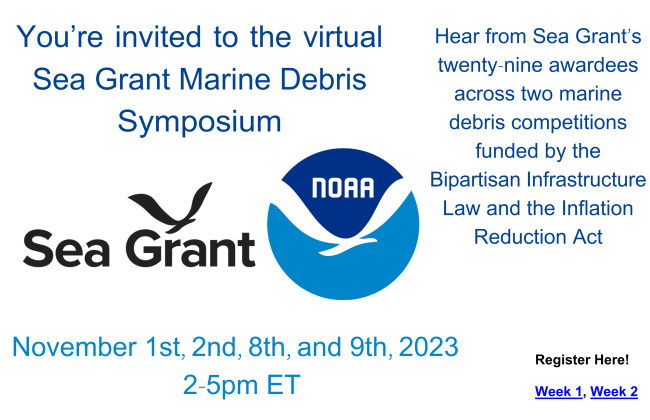
Join the National Sea Grant Program on November 1st, 2nd, 8th, and 9th to learn about the 29 projects awarded across the 2022 Marine Debris Challenge and Community Action Coalition competitions funded by the Bipartisan Infrastructure Law and the Inflation Reduction Act. View the agenda here. Register for Week One and/or Week Two. Learn more about the symposium here.
For this project, New Jersey Sea Grant Consortium (NJSGC) will partner with Columbia University through its Eco Ambassador program and with New York Sea Grant (NYSG) to develop effective marine debris curricula while expanding environmental literacy outreach to K-12 students from marginalized communities located in New Jersey and New York urban watersheds.
NJSGC Director of Education Diana Burich, adds “We are very excited to be collaborating with our partners to expand environmental literacy and plastic pollution awareness throughout the NY-NJ area’s urban watershed communities. Through the EcoEmbassadors Program, K-12 students from traditionally underserved and marginalized communities will learn about the pervasive problem of plastics in their local waterways and will become empowered to find solutions and take action to create a more sustainable environment, which will ultimately have long-term effects on human health and the blue economy. We are grateful for the resources to work with the community and to have the opportunity to collaborate with a great group of colleagues in this important effort.” Diana Burich, who is lead principal investigator (PI) on the project, is excited to work with co-PI Radhika Iyengar, Ph.D., Director of Education, Center for Sustainable Development, The Earth Institute, Columbia University.