National Sea Grant announces New Jersey Sea Grant Consortium to receive funding to advance research into contaminants of emerging concern
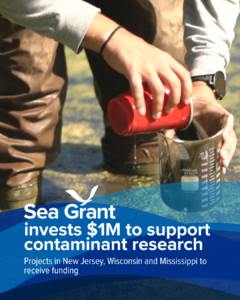
National Sea Grant has announced $1M in investments in 2026 to assess contaminants of emerging concern (CECs) throughout American coasts. This investment includes approximately $400,000 for a new project in the Northeast and approximately $300,000 each for two previously announced contaminant research awards in the Southeast and Great Lakes. Since 2021, Congress has directed Sea Grant to collaborate with state agencies and universities to expand research and monitoring on emerging contaminants. These projects were selected through competitive national opportunities focused on contaminants, and will advance regional efforts to research and monitor contaminants and build transferable frameworks that could be adopted by coastal cities and resource managers across the nation.
The Northeast project will be led by New Jersey Sea Grant Consortium’s (NJSGC) Executive Director, Dr. Peter M. Rowe, in partnership with two Consortium Member institutions. The co-Principal Investigators are Dr. Dibyendu Sarkar and Dr. Hadeer Saleh at Stevens Institute of Technology, and Dr. Yang Deng at Montclair State University. In this project, the team will develop a regional research program focusing on a variety of CECs, including PFAS (forever chemicals), which are a priority in New Jersey. More information on the project below:
New Jersey Sea Grant Consortium—$399,898
Understanding the impacts of CECs on urban coastal waters using metropolitan NY-NJ-CT as a model urban epicenter
New Jersey Sea Grant Consortium plans to design and execute a regional research funding program focused on understanding and monitoring contaminants in urban coastal and estuarine waters across the New York–New Jersey–Connecticut region. Over three years, the awardees will conduct a six-month scoping study leveraging literature reviews, machine learning and constituent engagement to identify critical contaminant sources, concentrations and impacts in urban waters. Following this baseline assessment, the team will administer a competitive sub-grant program to fund six to eight localized research projects across the tri-state area to address identified knowledge gaps. The investigators anticipate that integrating these findings into a strategic framework could help reduce urban contaminant pollution and mitigate its environmental, economic and social impacts. Ultimately, this initiative aims to inform water resource managers, policymakers, state agencies and urban coastal communities with improved contaminant management strategies; safeguard drinking water and local fisheries; and deliver a transferable framework that coastal cities nationwide could adopt.